The 7 Best Kayak Roof Racks for 2026
Kayak Gear Review Hub may earn a commission from qualifying purchases made through links on this page. This does not affect our editorial independence or product rankings.
The best kayak roof rack for most paddlers is the Malone Downloader Folding J-Style Kayak Carrier — the most trusted name in kayak transport with 666 verified reviews at 4.6 stars, a folding design that reduces highway drag, and everything you need right out of the box. If your vehicle doesn’t have crossbars, the HEYTRIP Universal Soft Roof Rack Pads mount to any roof rail with no hardware and cost under $60. We evaluated 11 options across J-style, saddle, and foam-based systems to find the best roof racks for solo paddlers, touring kayakers, and anyone who just needs to get their boat from the driveway to the water without a disaster.
Key Takeaways
- Best Overall: Malone Downloader — the most trusted brand, best review profile, includes everything
- Best for Vehicles Without Crossbars: HEYTRIP Soft Roof Rack Pads — no hardware needed, under $60
- Best for Composite/Touring Kayaks: Malone SeaWing Saddle Style — V-cradles protect expensive hulls
- Best Budget J-Bar: Heavy Duty J-Bar Kayak Rack — 2,062 reviews, complete set with straps, under $75
- Best Premium Pick: Thule Hull-a-Port XTR — pre-assembled, lockable, aluminum, lifetime warranty
- Best Mid-Range Aluminum: Aluminum 3-in-1 Kayak Rack — lighter than steel, under $90
- Best Foam Block Option: attwood Car-Top Kayak Carrier Kit — from a real marine brand, under $40
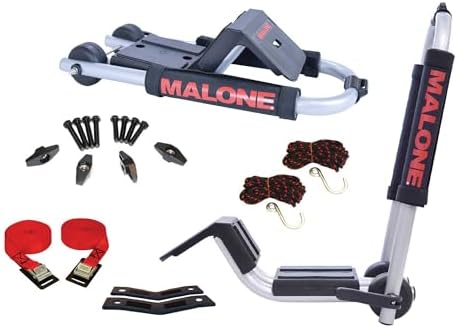
1. Malone Downloader Folding J-Style Kayak Carrier — Best Overall
Price: $$ | Buy from: Amazon
The Malone Downloader Folding J-Style Kayak Carrier is our top pick for most kayakers — and it’s not a close call. Malone has been the go-to brand for kayak transport gear among serious paddlers for years, and the Downloader is their flagship J-style rack. It earns that position the hard way: 666 verified Amazon reviews at 4.6 stars, which is one of the strongest review profiles in the kayak rack category.
The folding design is genuinely useful. When the rack is empty, it folds flat against the crossbar, cutting wind resistance significantly on the highway. You’ll notice it on longer drives — less wind noise, less fuel drain, and no rattling from an empty metal arm battering against the bar. When you’re ready to load, it snaps open, you set the kayak in the J position, run the cam straps, clip the bow and stern lines included in the box, and you’re done. Everything needed is in the package — hardware, tie-downs, the works.
What separates the Malone from the generic J-bars is the brand support and build quality. Malone has been in this space long enough that their mounting hardware fits virtually every crossbar system on the market, and if you have a problem, there are actual customer service contacts and replacement parts available. That’s not something you can say about the no-name steel racks that flood the Amazon listings.
If there’s a weakness, it’s the price. At around $170, the Downloader is a real investment compared to the budget alternatives. But for paddlers who carry their kayak every weekend, a rack that lasts five years rather than two is actually the better value.
Key Specifications
- Style: Folding J-style
- Fits: Kayaks up to 35 inches wide
- Construction: Steel with rust-resistant coating
- Includes: Bow and stern tie-down lines, mounting hardware
- Price Range: $$
2. HEYTRIP Universal Soft Roof Rack Pads — Best for Vehicles Without Crossbars

Price: $ | Buy from: Amazon
The HEYTRIP Universal Soft Roof Rack Pads solve a problem that any J-bar or saddle rack can’t: what do you do when your car doesn’t have crossbars? Whether you’re renting a vehicle, driving a car with bare roof rails, or just don’t want to commit to a full crossbar system, soft pads are the answer — and HEYTRIP’s kit is the best-reviewed option in the category, with 1,278 ratings at 4.4 stars.
The setup is simple. You strap two thick EVA foam pads across your roof using the vehicle’s doors. The pads protect your roof’s finish and the kayak’s hull. You set the kayak on top, then run the included 15-foot tie-down straps through the vehicle interior and out the windows on both sides. Tighten them down and add your bow and stern lines, and you’re ready to drive.
The biggest advantage is portability. The whole kit rolls up into the included storage bag — you can stash it in a gear bag, bring it on a rental car trip, or lend it to a friend without handing over your entire roof rack setup. If you paddle a few times a year or you’re testing out kayaking before investing in a full system, soft pads are by far the most sensible starting point.
That said, soft pads have real limits. They’re less secure than mechanical J-bar or saddle systems, especially at sustained highway speeds. Keep it at or below 65 mph, check the straps before every drive, and use bow and stern lines without exception. This isn’t the setup for a six-hour highway trip at 80 mph — it’s for getting to the lake 30 minutes away.
Key Specifications
- Style: Soft foam pads
- Crossbars Required: No
- Foam: Thick EVA with anti-slip base
- Straps: 15ft heavy-duty tie-downs included
- Extras: Includes storage bag
- Price Range: $
3. Malone SeaWing Saddle Style Kayak Carrier — Best for Composite and Touring Kayaks

Price: $$ | Buy from: Amazon
If you’re paddling a fiberglass, Kevlar, or composite kayak, the Malone SeaWing Saddle Style Kayak Carrier is worth the upgrade over a standard J-bar. Here’s why: J-style racks hold the kayak on its side, concentrating the boat’s weight on a narrow strip of hull along one rail. That’s fine for a rotationally molded plastic kayak that can take some flex. It’s not ideal for a $3,000 composite touring kayak where any deformation of the hull is a problem.
The SeaWing uses V-shaped saddle cradles that let the kayak rest upright in a natural position, distributing weight evenly along the hull’s keel and lower sides. There are no pressure points, no asymmetric loading, and no risk of deforming a composite hull over repeated trips. The 70-pound weight capacity means it handles most tandem kayaks as well as any single.
Malone’s Jawz universal mounting system is a real quality-of-life feature. It clamps onto round, square, or aero crossbars without tools — you hand-tighten two bolts and it’s locked in. On a cold morning at the put-in, not fumbling with an Allen wrench matters. The no-tool design also makes swapping between vehicles straightforward if you shuttle kayaks between different cars.
The tradeoff vs a J-bar is roof real estate. Saddle racks hold the kayak flat on top, which takes up more roof width than the side-load J position. If you’re running two kayaks on a single vehicle, two saddle setups require a wider crossbar span than two J-bars. For single-kayak paddlers with a serious boat, it’s the right choice every time.
Key Specifications
- Style: Saddle / V-cradle
- Weight Capacity: 70 lbs
- Mounting: Jawz no-tool universal system
- Construction: Nylon with corrosion-resistant hardware
- Includes: Bow and stern tie-down lines
- Price Range: $$
4. Heavy Duty J-Bar Kayak Roof Rack with 4 Ratchet Straps — Best Budget J-Bar

Price: $ | Buy from: Amazon
The Heavy Duty J-Bar Kayak Roof Rack doesn’t have a famous brand name behind it, but it has something that speaks louder: 2,062 Amazon reviews. That’s the highest review count among J-style racks in this category, and a 4.3-star average across that volume of purchases means a lot of paddlers have put their boats on the highway on this rack and driven home satisfied.
The value equation is straightforward. You get two pairs of J-bars — a complete setup for two kayaks — plus four ratchet tie-down straps, all for under $75. Compare that to the Malone Downloader at $170 for a single pair, and you understand who this is for: paddlers who kayak a handful of times per season and don’t want to spend more on the rack than they might spend on the paddle.
Steel construction is heavier than aluminum, which means slightly more wind resistance when empty. It also means that if there’s a scratch in the coating, rust can start. Keep an eye on contact points with the crossbar after wet trips and you’ll get years out of this rack. The arm width is adjustable, which covers most kayak beam widths without problem.
The honest caveat is that there’s no manufacturer support to speak of. If a piece fails or a mounting bolt strips out, you’re replacing the whole thing. For occasional paddlers, that’s an acceptable risk at this price point. For paddlers who are on the water every weekend, the Malone’s build quality is worth the investment.
Key Specifications
- Style: J-style
- Includes: 2 pairs + 4 ratchet straps
- Construction: Heavy duty steel
- Mounting: Universal crossbar fit
- Review Count: 2,062 reviews
- Price Range: $
5. Thule Hull-a-Port XTR Kayak J-Style Roof Rack — Best Premium Pick

Price: $$$ | Buy from: Amazon
The Thule Hull-a-Port XTR is the right answer when you want the best and price isn’t the primary filter. Thule is the global benchmark for roof rack systems — their crossbars and load carriers are standard equipment on premium vehicles from BMW to Subaru, and their kayak racks carry that same engineering quality.
The Hull-a-Port XTR comes pre-assembled. Unbox it, mount it to your crossbar, and it’s ready to load. There’s no step where you’re on the driveway reading a manual and sorting through a bag of hardware. For a car that lives at the trailhead or a paddler who loads in the dark at 5 a.m., pre-assembled matters. The fold-flat design means when you’re not carrying a kayak, it drops completely flat — clean profile, minimal drag.
The integrated lock barrel is a genuine differentiator in this category. No other J-bar rack at this price point has any theft deterrent. The lock core is sold separately (Thule One-Key system), which is an extra cost, but the option exists — which it doesn’t on Malone or any of the generic racks. For paddlers who leave their rack on the car at work or overnight, that matters.
At $279, this is a serious commitment. But Thule backs aluminum components with a limited lifetime warranty, and these racks are built to stay on the car for the long haul. If you’re the kind of paddler who buys once and buys right, the Hull-a-Port XTR earns it.
Key Specifications
- Style: Folding J-style
- Capacity: Up to 2 kayaks
- Construction: Aluminum
- Features: Pre-assembled, folds flat, lockable (lock core sold separately)
- Warranty: Limited lifetime on aluminum components
- Price Range: $$$
6. Aluminum 3-in-1 Kayak Roof Rack — Best Mid-Range Aluminum Option

Price: $ | Buy from: Amazon
The Aluminum 3-in-1 Kayak Roof Rack occupies a real gap in the market: aluminum construction without Thule or Malone pricing. At under $90, you get a lighter rack than the budget steel options, with 1,263 reviews at 4.3 stars backing up the quality claims.
Aluminum matters for two reasons. Weight is the obvious one — a lighter rack means slightly less weight at the top of your vehicle, better fuel economy on long hauls, and easier installation if you’re putting it on and taking it off seasonally. The less obvious advantage is corrosion resistance. Steel racks that lose their coating rust; aluminum oxidizes but doesn’t rust through. For paddlers who live near saltwater or don’t always have time to dry off the rack after a wet trip, aluminum is a longer-term investment.
The 3-in-1 adjustable design is useful. The arm angle adjusts between J-position, angled, and near-flat configurations, which means you can adapt it for different kayak widths or even use it for a SUP or surfboard in a different position. Universal crossbar mounting covers most bar profiles. The foldable design reduces profile when empty.
There are no straps included, which is a real gap at this price — budget and mid-range alternatives from generic brands tend to include them. Add a pair of cam straps to your order and you’re still well under $100 total. If you want aluminum at a fair price and can overlook the missing straps, this is the gap-filler between generic steel and premium branded.
Key Specifications
- Style: J-style / adjustable multi-position
- Construction: Aluminum
- Folding: Yes
- Straps Included: No (purchase separately)
- Review Count: 1,263 reviews at 4.3 stars
- Price Range: $
7. attwood Universal Car-Top Kayak Carrier Kit with Foam Blocks — Best Budget Foam Block Option

Price: $ | Buy from: Amazon
The attwood Universal Car-Top Kayak Carrier Kit rounds out the list as the cheapest viable way to get a kayak on a car. At $37, it’s the entry point — and unlike a lot of cheap foam kits, it comes from attwood, a legitimate marine accessories brand that’s been making boat hardware since the 1930s. That brand heritage doesn’t guarantee anything, but it’s a step above truly generic foam with no accountability behind it.
The kit is exactly what it sounds like: shaped foam blocks that cradle the kayak on your roof, plus tie-down straps to secure it. No crossbars required. You strap the foam to your roof, set the kayak in, run straps through the car, and drive. It’s the simplest possible transport solution, and for short trips to a nearby lake, it works.
The limitations are real and worth stating plainly. Foam blocks don’t grip crossbars — they just sit between your roof and the hull. If a strap loosens on the highway, there’s nothing mechanical holding the kayak in place. Keep speeds under 55 mph if you’re doing any highway driving, always use bow and stern lines, check the straps every stop, and don’t use this system for long trips.
If you paddle twice a summer and the put-in is 20 minutes away, this does the job. If you paddle every weekend, invest in a J-bar or soft pad system that’s more secure and will outlast the foam.
Key Specifications
- Style: Foam block
- Brand: attwood (established marine accessories brand)
- Crossbars Required: No
- Includes: Foam blocks + tie-down straps
- Review Count: 1,459 reviews at 4.2 stars
- Price Range: $
Kayak Roof Rack Buying Guide
J-Style vs Saddle vs Foam: Which Rack Type Is Right for You
The three main rack styles each serve a different paddler profile.
J-style racks (J-bars) are the most popular by far. They hold the kayak on its side at roughly a 45-degree angle, like the curve of the letter J. This positions the kayak efficiently — it takes up minimal roof width, which means you can carry two kayaks side by side on one vehicle. J-bars work well for polyethylene (plastic) kayaks, which make up the vast majority of recreational boats. The Malone Downloader and the budget J-bar options in this list are all J-style.
Saddle-style racks hold the kayak upright in V-shaped cradles, letting it rest as it would in the water. The hull sits evenly distributed across padded contact points rather than balanced on one edge. This is the right choice for fiberglass, Kevlar, or composite kayaks where hull flex and pressure points are a concern. The Malone SeaWing is the standout saddle option on this list.
Soft pads and foam blocks skip the mechanical mounting entirely. They’re the solution for vehicles without crossbars, for occasional paddlers, or for anyone who needs the cheapest viable transport method. Less secure, requires care with speed and strap monitoring, but genuinely useful for the right use case.
Do You Need Crossbars First?
J-style and saddle racks require crossbars — horizontal bars that span your vehicle’s roof, running side to side. Most modern SUVs and wagons come with roof rails (the bars that run front to back), but not all have factory crossbars. Before ordering any J-bar or saddle rack, check whether your vehicle has crossbars that span the roof from side to side.
If you don’t have crossbars, your options are: (1) buy a crossbar system first (Thule, Yakima, or Malone all make universal crossbar kits), then add a J-bar or saddle rack; or (2) start with soft pads or foam blocks that mount directly to the roof. For paddlers who plan to transport kayaks regularly, investing in a proper crossbar system plus a quality rack is the right long-term play.
Weight Capacity: How Much Do You Actually Need
Most recreational kayaks weigh between 35 and 65 pounds. Sit-on-top fishing kayaks tend to run heavier — some pedal drive models push 80 to 100 pounds. Tandem kayaks can reach 65 to 80 pounds for plastic versions.
The Malone SeaWing’s 70-pound capacity handles all recreational single kayaks and most tandems. For heavy fishing kayaks or fully loaded tandem boats, check the specific weight listed for your kayak and compare it to the rack’s rated capacity, then add a 20% safety buffer. If your kayak is 70 pounds, you want a rack rated for at least 84 pounds.
Most J-bar racks don’t publish a specific weight capacity — they’re designed for standard recreational kayaks and are adequate for anything under 70 pounds. If you’re regularly transporting very heavy boats, the Malone SeaWing’s explicit 70-pound rating is worth paying attention to.
Protecting Your Kayak Hull During Transport
The most common transport damage isn’t from accidents — it’s from straps overtightened over many trips, gradually deforming a plastic hull. This is called “oil canning,” and it’s the most common repair issue for used plastic kayaks.
To prevent it: use cam straps (not ratchet straps) for the main body of the kayak, tighten them snug but not cranked down, and add padding at any contact point where there’s a hard edge. Bow and stern lines should be taut but not under high tension — they’re there to prevent the nose from lifting, not to haul the boat down.
Saddle-style racks reduce hull pressure by distributing the load across the full hull width. If you have an expensive composite kayak, the Malone SeaWing’s cradle design is worth the extra cost over a J-bar specifically because it eliminates point loading.
Speed, Security, and the Case for Quality Hardware
Every kayak rack manufacturer publishes a maximum speed recommendation, and they exist for a reason. At 70+ mph, the aerodynamic forces on a rooftop kayak are significant — the bow acts like a wing and wants to lift, while the stern drags. Bow and stern lines counteract this by anchoring both ends of the kayak independently from the main straps.
Always use bow and stern lines. Many states actually require them legally, and they’re your safety net if a main strap loosens. The Malone Downloader and SeaWing both include them. If your rack doesn’t, buy a set separately before your first trip.
For racks themselves, quality hardware matters at highway speeds. The Thule and Malone racks use tested mounting systems designed to hold under load. Generic steel racks can work fine for years — but inspect the mounting hardware before every highway trip, especially after winter storage. A mount that loosened over the winter is not something you want to discover at 65 mph.
Frequently Asked Questions
What is the best kayak roof rack?
The best kayak roof rack for most paddlers is the Malone Downloader Folding J-Style Kayak Carrier. It comes from the most respected brand in kayak transport gear, has 666 reviews at 4.6 stars — the strongest review profile in the category — and ships with all the hardware and tie-down lines you need. For vehicles without crossbars, the HEYTRIP Universal Soft Roof Rack Pads are the best no-hardware solution at under $60.
Can I transport a kayak without crossbars?
Yes. Soft roof rack pads like the HEYTRIP mount directly to your roof rails or bare roof and use long tie-down straps to secure the kayak. Foam block kits like the attwood Carrier Kit also work without crossbars. These systems are less secure than J-bar or saddle racks, so keep speeds at or below 60 mph, check straps before every drive, and always use bow and stern lines anchored to solid attachment points on the vehicle.
What is a J-style kayak rack?
A J-style kayak rack holds the kayak on its side in a J-shaped cradle — the boat leans at roughly a 45-degree angle rather than lying flat on the roof. This uses less roof width and is the standard loading style for recreational kayaks. It also makes it easier to load solo: you tilt the kayak up onto one side and slide it into position rather than lifting it fully overhead. Malone, Thule, and most generic brands make J-style racks.
What is the difference between J-style and saddle-style kayak racks?
J-style racks hold the kayak on its side, which uses less roof width and works well for plastic kayaks. Saddle-style racks hold the kayak upright in V-shaped cradles, distributing the hull’s weight evenly across padded contact points. Saddle style is the preferred choice for fiberglass and composite kayaks where concentrated hull pressure over time can cause deformation. If you have a plastic recreational kayak, either style works. If you have an expensive touring or composite kayak, go with saddle style.
How fast can I drive with a kayak on my roof?
Most manufacturers recommend at or below 65 mph with a properly secured kayak on a quality rack. With soft pads or foam blocks, keep it at or below 55 mph. Always use bow and stern lines — these prevent the front of the kayak from lifting at speed, which can cause progressive strap failure. Check straps at every gas stop on a highway trip. If straps look loose, pull over and retighten before continuing.
Do I need bow and stern tie-down lines?
Yes. Bow and stern lines anchor the front and back of the kayak independently from the main crossbar straps. At highway speeds, aerodynamic lift on the bow can progressively loosen main straps — the bow line prevents this entirely. Many states legally require them when transporting boats. The Malone Downloader and SeaWing both include them. If your rack doesn’t come with them, buy a set of cam straps and anchor them to solid tow hooks or bumper brackets front and rear.
Final Thoughts
Getting your kayak transport setup right is a one-time problem. Buy the right rack for your vehicle and your boat, learn to strap it correctly, and you’ll load and unload in under five minutes for years. The Malone Downloader is the right call for most paddlers — trusted brand, best review profile in the category, includes everything, and the folding design means you actually want to leave it on the car between trips. If your vehicle doesn’t have crossbars, start with the HEYTRIP Soft Roof Rack Pads and you’re on the water without a major hardware investment.
Whatever you choose, use bow and stern lines. Always. A kayak on the highway is a serious road hazard if it comes loose — treat it accordingly and it never will.
If you have questions about choosing a rack for your specific vehicle or kayak, leave a comment below. Also check out our guide to the best kayak carts for getting your boat from car to water once you’ve arrived, and the best dry bags for kayaking to keep your gear protected on the water.